Inventory Changes
There are different inventory changes in different business scenarios, and the following is a demonstration of the inventory changes in these business scenarios.
Purchase
For more information on how to purchase, please click here to view the purchase order management playbook.
The following is an example of a change in inventory as a result of a purchasing action:
Create a PO (Purchase Order) for 100 pieces of item A, with a purchase cost of 50, to be warehoused to W01.

Check the change in inventory for W01, Commodity A purchased 100 units at an average cost of 50 and an inventory balance of 5000.

On the same day, create a PO to purchase 100 pieces of item A with a purchase price of 70, and warehouse it to W01.

Check the inventory movement for W01, Commodity A purchased 200 units.
Average cost: (100x50+100x70)/(100+100)=60, inventory balance 200, inventory balance 12000.

Create PO, purchase 50 pieces of item B, purchase price 10, warehouse to W01.

On the W01 Statement of Changes in Inventory, Merchandise B is purchased in quantities of 50 with an average cost of 10, an inventory balance of 50, and an inventory balance of 500.

Dispatch
For information on how to make a stock transfer, please click here to view the inventory playbook.
The following is an example of a change in inventory as a result of a stock transfer:
Create a transfer order to transfer 30 pieces of item A from W01 to S01.
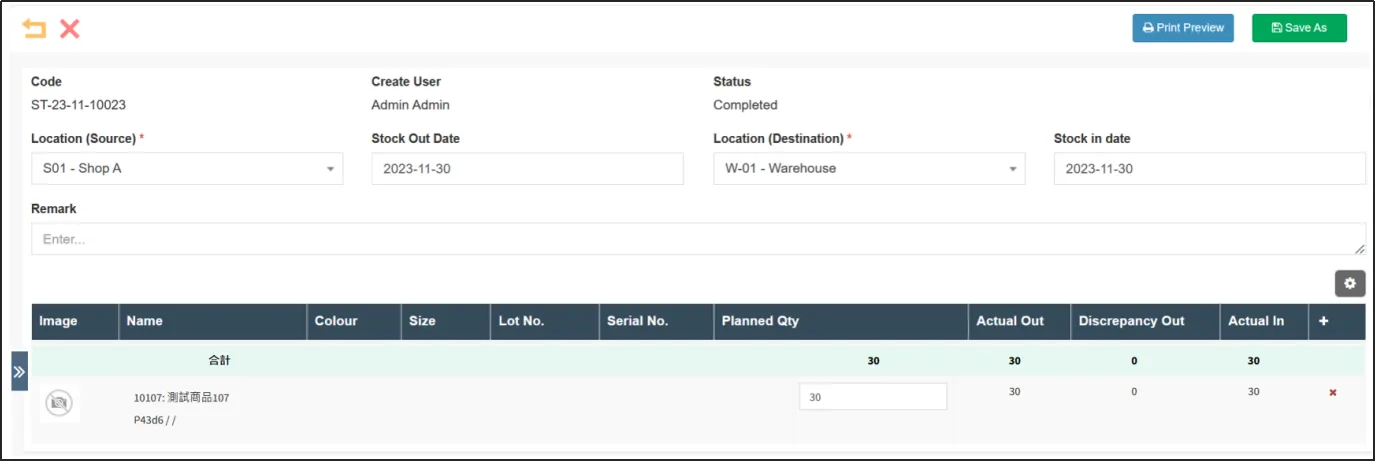
On the W01 Statement of Changes in Inventory, Commodity A is out of stock by 30 units at an average cost of $60, with an inventory balance of 170 units and a W01 inventory balance of 10,200.

In S01 Statement of Changes in Inventory, Merchandise A has 30 units in stock, an inventory balance of 30 units, an average cost of 60, and an inventory balance of 1,800.

On the same day, a transfer order is created to transfer 20 pieces of Commodity A from W01 to S02.
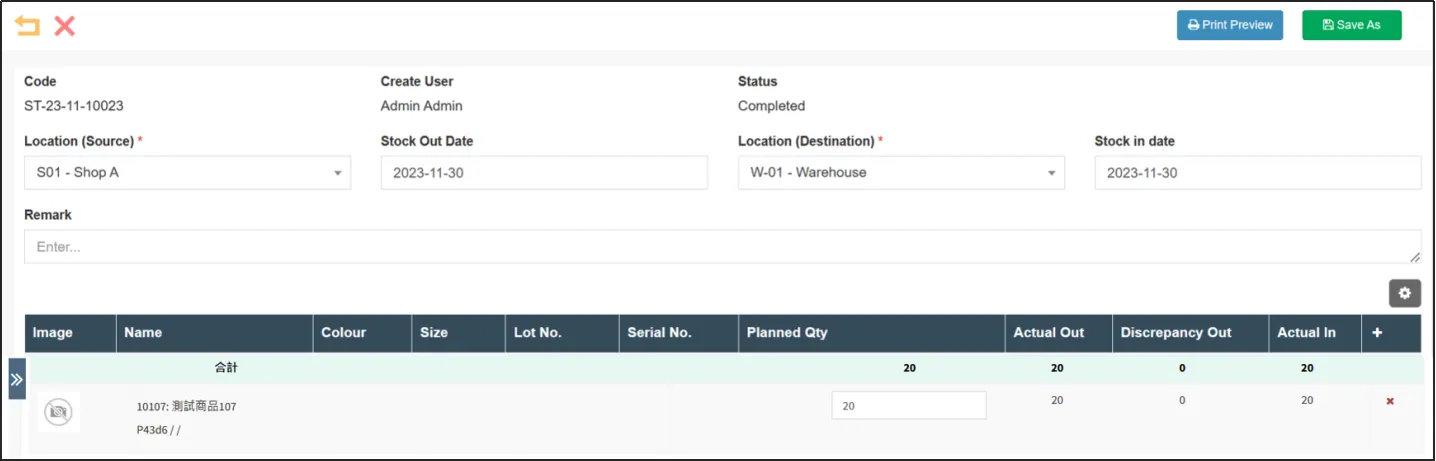
In W01 Statement of Changes in Inventory, Merchandise A has a total of 50 units out of stock at an average cost of $60, an inventory balance of 150 units, and an inventory balance of 9,000.
In the S02 Statement of Changes in Inventory, 20 units of Commodity A are warehoused, the S02 inventory balance is 20 units, the average cost is 60, and the S02 inventory balance is 1,200.
Sales
For more information on how to sell, please click here to view online store order process playbookand POS Order Processplaybook.
The following is an example of a change in inventory due to sales behavior:
Eshop opens an order for the sale of item A 10 pieces.
In W01 Statement of Changes in Inventory, Merchandise A sells 10 units at an average cost of 60, has a sellable inventory balance of 140, a Stock on hand of 150, and an inventory balance of 9,000.

Finish out of the warehouse.
On the W01 Statement of Changes in Inventory, Merchandise A sells 10 units at an average cost of 60, has a sellable inventory balance of 140 units, a Stock on hand of 140 units, and an inventory balance of 8400.

Cancel
For information on how to cancel, please click here to view POS Order Process playbook.
The following is an example of a write-off action that results in a change in inventory:
Eshop cancels the R2 order (order after return and exchange) for purchase of item A.
In W01 Statement of Changes in Inventory, Merchandise A has 5 write-off orders, an average cost of 60, an inventory balance of 150, and an inventory balance of 9,000.
Stock Take
Please click here for more information on how to order positions Stock Take playbook.
The following is an example of a stocktaking behavior that results in a change in inventory:
S01 Decrease of 1 item in Stocktaking Commodity A.

In the S01 Statement of Changes in Inventory, Commodity A is counted as -1 item with an average cost of 60, an inventory balance of 29, and an inventory balance of 1,740.

S01 Increase of 6 pieces for stock item A.

In the S01 Statement of Changes in Inventory, Merchandise A has a stock count of 5, an average cost of 60, an inventory balance of 35, and an inventory balance of 2100.

Credit Note And Debit Note
For information on how to use Credit Note and Debit Note, click here to view the Credit Credit Note and Debit Note playbook.
The following is an example of a Debit Nore behavior that causes a change in inventory:
Open a Debit Note to the vendor to return 20 pieces of Item A at a cost of $70 from W01.

View the Inventory Movement statement for W01.
In the W01 Statement of Changes in Inventory, Commodity A shipped: 20 pieces, W01 ending inventory 210, average cost: (210*55.65-20*70)/(230-20) = 48.98, ending balance 10286.5.
The following is an example of a Credit Nore behavior that causes a change in inventory:
Open a Credit Note to a B2C member to return 20 units of item A with a return price of 70 from W01.

View the Inventory Movement statement for W01.
In the W01 Statement of Changes in Inventory, Merchandise A is returned: 20 pieces W01 Ending Inventory 230, Average Cost: 48.98, Ending Balance 11265.4.
Dayback list
Dayback single that is the past documents, three days before the purchase order, seven days before the warehouse orders, etc., these for various reasons in the past to make up for the bill is Dayback single.
The following is an example of an open Dayback single action that causes a change in inventory:
Create a PO, purchase 200 pieces of item A at a purchase price of 40, and put it into W01. the purchase date is the day before the test date.

On the previous day's W01 Statement of Changes in Inventory, Merchandise A was purchased in quantities of 200 at an average cost of 40, with an inventory balance of 200 and an inventory balance of 8,000.
In today's W01 Statement of Changes in Inventory, Commodity A begins at 200, has an average cost of 40, ends at 200, and has an inventory balance of 8000.

Average cost
Average cost refers to the average of the purchase costs of the purchased commodities.
The following are three actions that can change the average cost of goods: purchases, returns to suppliers, and depreciation of goods.
Purchasing is the most frequently occurring behavior that changes average cost.
Purchasing is one of the behaviors that changes the average cost of goods.
The original average cost calculation:
New Average Cost = (Procurement Cost of First Purchase x Quantity of First Purchase + Procurement Cost of Second Purchase x Quantity of Second Purchase + ...... + Procurement Cost of This Purchase x Quantity of This Purchase) / (Quantity of First Purchase + Quantity of Second Purchase + ...... + Quantity of This Purchase)
As this method of calculation will account for each purchase in the past, but with the development of time, there may be a great change in prices, the previous procurement cost and the present compared with a considerable difference, is no longer suitable for calculation to the average cost of the situation.
For this situation, Posify has optimized the calculation of average cost.
Optimized average cost calculation:
New Average Cost = (Current Average Cost x Current Inventory + Current Purchase Cost x Current Purchase Quantity) / (Current Inventory + Current Purchase Quantity)
Purchasing changes the average cost of an item.
The following is an example of a purchase that results in a change in average cost:
Create a PO (Purchase Order) for 100 pieces of item A, with a purchase cost of 90, to be warehoused to W01.

Check the change in inventory for W01, Commodity A purchased 100 units at an average cost of 50 and an inventory balance of 5000.

On the same day, create a PO to purchase 100 pieces of item A with a purchase price of 70, and warehouse it to W01.

Check the inventory movement for W01, Commodity A purchased 200 units.
Average cost: (100x50+100x70)/(100+100)=60, inventory balance 200, inventory balance $12000.

Sell 70 units of item A with a W01 inventory balance of 130 at an average cost of $60 (the sale does not result in a change in average cost).

Create PO, purchase 100 pieces of item A, purchase price $50, warehouse to W01.

Check the change in inventory for W01, Commodity A purchased 300 pieces, W01 has an inventory balance of 230, average cost = (130*60+100*50)/(130+100) = 55.65, and inventory balance of 12799.5.

Returns to suppliers (Debit Note)
The following is an example of a return to a supplier that results in a change in average cost:
Open a Debit Note to the supplier to return 20 units of Item A with a return cost of 70 from W01.
View the Inventory Movement statement for W01.

In the W01 Statement of Changes in Inventory, Commodity A is out of stock: 20 pieces W01 Ending Inventory 210, Average Cost: (210*55.65-20*70)/(230-20) = 48.98, Ending Balance 10286.5.
New Average Cost = (Beginning Inventory x Beginning Average Cost - Number of Returns x Cost of Returns) / Ending Inventory.
Write Off
The following is an example of a change in average cost due to cost depreciation:
Purchase four (4) pieces of Item C for a purchase price of $90 seven (7) days prior to the date of the test.

Commodity C ending inventory in W01: 4, average cost: 90, ending balance: 360. Average cost: 90, ending balance: 360.
W01 added 25 new purchases of Commodity C at a purchase price of 88.

Check the W01 Statement of Changes in Inventory, 25 pieces were purchased, ending inventory is 29, and average cost = (4*90+25*88)/(25+4)=88.28.
Depreciate the cost of Commodity C seven days prior to the date of the test to 81.
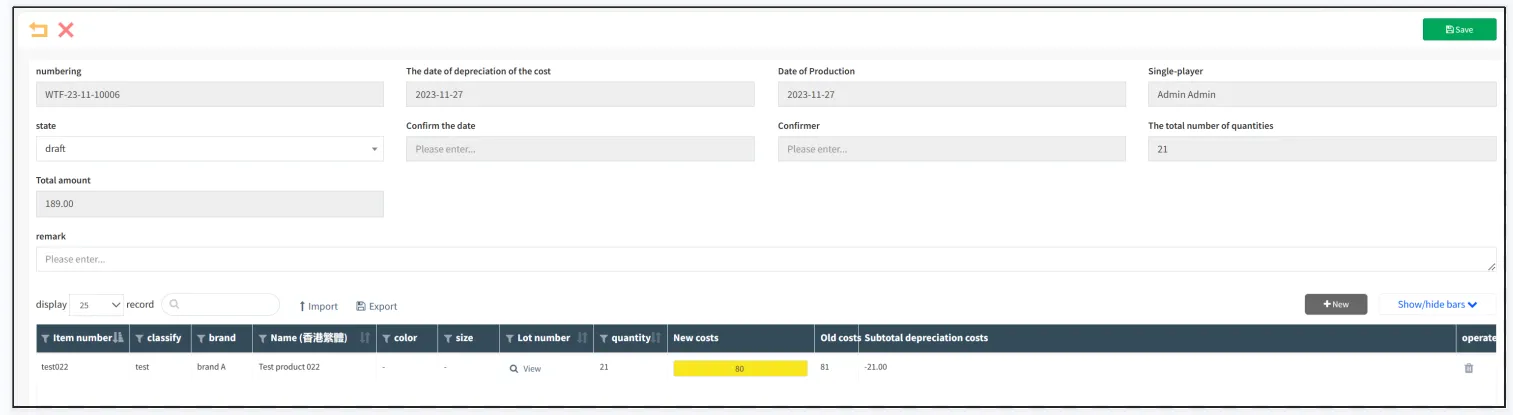
View W01 7 Days Ago Statement of Changes in Inventory, Ending Inventory 4, Average Cost 81, Ending Balance 324.
Check the inventory movement statement for W01 on the day of the test, 25 pieces were purchased, average cost: (4*81+25*88)/(25+4)=87.03, ending inventory: 29, ending balance 2524.
New Average Cost = (Ending Inventory at Depreciation Date x New Cost after Depreciation + Quantity x Purchase Cost for each new increase in purchases after the Depreciation Date) / Inventory Now.